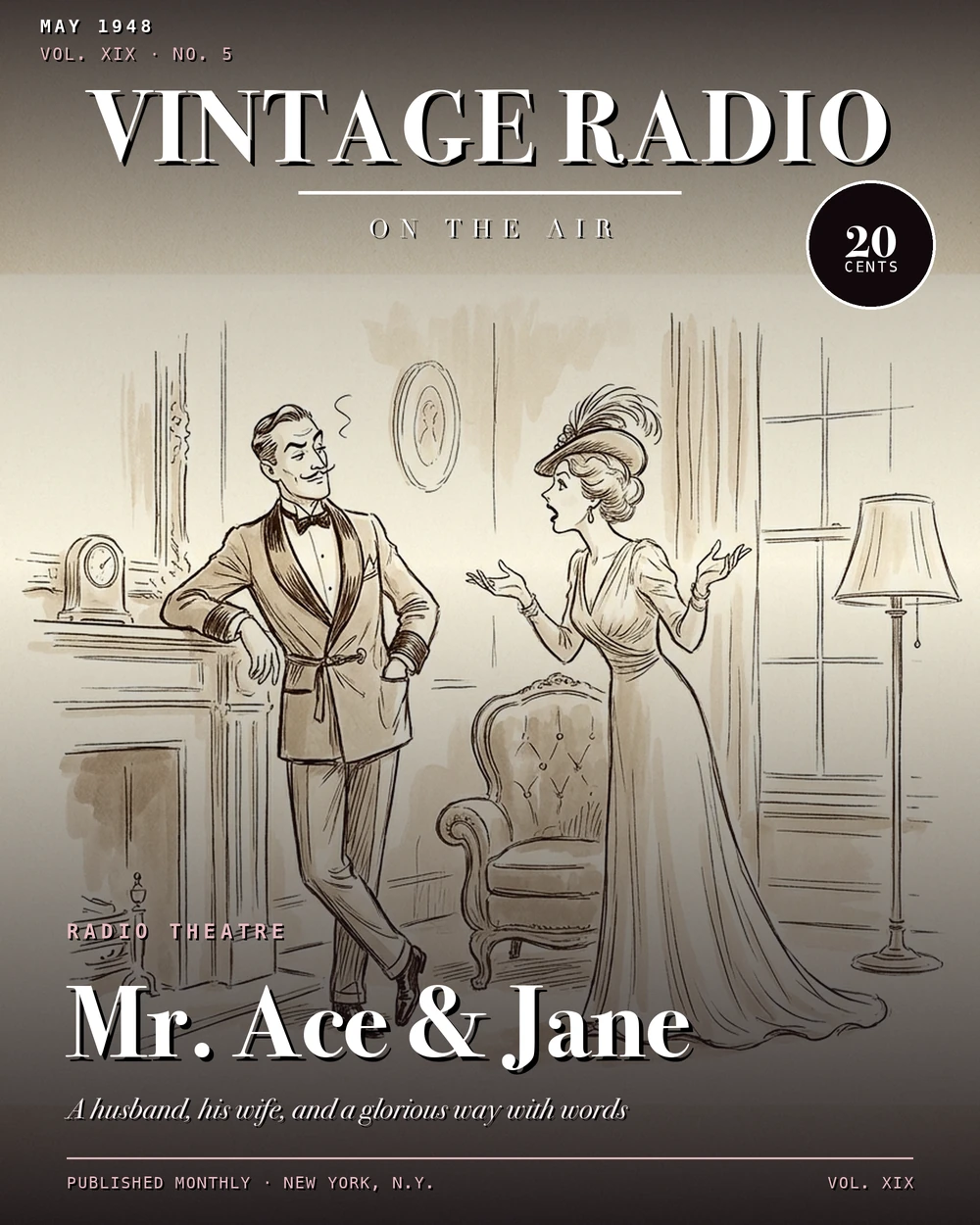
Mr. Ace & Jane
The Show Behind the Show
Mr. Ace and Jane was never quite a new idea — and that was entirely the point. When Goodman Ace brought the series to CBS on January 16, 1948, he was reviving something he and his wife Jane had already spent fifteen years perfecting. Their original program, Easy Aces, had run from 1930 to 1945 as a fifteen-minute serialized comedy built around the two of them playing a bickering, affectionate married couple. Mr. Ace and Jane was the same couple, the same dynamic, and the same writer — but now expanded to a half-hour, recorded live before a studio audience on Saturday nights at seven o'clock, and given a fresh context: Goodman's character traded in his original occupation as a real estate salesman for a new role as an advertising "idea man."
Goodman created and wrote the series himself, as he had done with Easy Aces. His co-star was Jane Ace, born Jane Epstein on October 12, 1897, the real-life wife whose deadpan delivery had made the original show famous. The stylized title — officially rendered as "mr. ace and JANE," all lowercase on the first half and all caps on the second — was Goodman's own invention, a small piece of typographic wit that said something about where the power in the relationship really sat.
Jane's Malapropisms and What Made the Writing Work
The signature feature carried over intact from Easy Aces was Jane's malapropisms. Fans called them "Jane-isms," and they were genuinely inventive: "Time wounds all heels" and "we are all cremated equal" were among the most quoted. These weren't throwaway gags but carefully constructed inversions that required the listener to catch the original phrase underneath the mangled version. They rewarded attention.
Goodman's contribution was equally distinctive. Critic John Crosby of the New York Herald-Tribune, reviewing the show in March 1948, praised Ace's dry, resigned narration and called the couple's cross-purpose conversations "masterpieces." The humor worked because the two characters were perpetually talking past each other — Goodman would set up a perfectly logical statement, and Jane would deflect it sideways with an earnest non sequitur. Mr. Ace came across as bumbling yet patient, Jane as quick-witted in her own oblique way. It was a comic engine that had been running smoothly for nearly two decades by the time the revival launched.
The Cast and Their Characters
The revival assembled a full supporting ensemble around the central couple. Mary Hunter played Marge, the Aces' best friend who also boarded with them. Paul Stewart played Johnny, Jane's ne'er-do-well brother-in-law. Martin Gabel appeared as Neil Williams, a newspaper reporter romantically interested in Marge. Helene Dumas played Laura, the Southern maid. Ken Roberts had a unique double role — he played Cokie, a neighbor who happened to be a radio announcer, while also serving as the show's actual on-air announcer, essentially playing himself inside the fiction.
The revival also introduced some new faces. Leon Janney took over the ne'er-do-well brother role under the name Paul rather than Johnny, and Eric Dressler played Mr. Norris, Goodman's advertising boss. Ann Thomas played Ace's secretary, Ethel Blume his niece Betty, Alfred Ryder her husband Carl Neff, and Peggy Allenby a nosy neighbor named Mrs. Benton. The episode titles alone give a sense of the domestic terrain: "Bridge Game," "Hiring a Maid," "The Mink Coat," "Jury Duty," "That's No Lady, That's My Wife." These were the small negotiations and minor catastrophes of postwar married life, played for laughs.
The Sponsor Trouble
The show launched with an unusual sponsor: the U.S. Army and Air Force Recruiting Service. It didn't last long. Episodes that spoofed jury duty and civil lawsuits struck the Army and Air Force as disrespectful of authority, and they withdrew their sponsorship. General Foods stepped in and advertised Jell-O for the remainder of the run. When that sponsorship ended, CBS kept the show on as a sustaining program — meaning the network broadcast it without a paying sponsor — for some additional months before eventually canceling it.
The cancellation came in May 1949, and Crosby, who had praised the show warmly, called it "a black day." For a program that had generated genuinely favorable press, it was a short life.
Why the Revival Struggled
The most pointed explanation offered at the time was also the most ironic: the live studio audience that CBS wanted for the half-hour format may have worked against the show's strengths. Easy Aces had thrived on an intimate, quiet conversational rhythm — just the two of them, close to the microphone, building an absurdist domestic world with low-key precision. Putting that same style in front of a laughing audience shifted the dynamic. The jokes that landed best in a living room with a radio, where the listener could follow each careful twist of language at their own pace, didn't necessarily land the same way in a room built for broader, more theatrical comedy.
The comparison made at the time to Abbott and Costello pointed at what the show wasn't quite. Abbott and Costello worked in broad strokes; the Aces worked in fine ones. The half-hour format and the studio audience pushed the show toward the former while its real virtues were in the latter.
What Came After
The end of Mr. Ace and Jane didn't close out the Aces' story entirely. In 1949 they brought the Easy Aces format to television on the DuMont Television Network as a fifteen-minute show, attempting to reconstruct the original intimate formula in a new medium. That run also lasted only one season. Jane Ace died on November 11, 1974.
Goodman went on to write for some of the biggest names in mid-century American broadcasting — The Big Show with Tallulah Bankhead, and later for Milton Berle, Bob Hope, and Perry Como. His talent as a writer outlasted the specific vehicle he and Jane had built together. Easy Aces, the show that Mr. Ace and Jane had tried to extend and update, was inducted into the Radio Hall of Fame in 1990, a recognition of how much the original had mattered.
Fifteen known episodes survive from the 1948 run, covering the full range of the show's domestic comedy: a loan company, a quiz show, a mink coat, a borrowed two hundred dollars. Small situations, carefully written, with Jane's malapropisms doing their sideways work throughout.